Why Series Stability in Precision Turned Parts Matters More Than Unit Price
Buyers responsible for sourcing precision turned parts compare quotations. That is entirely right. Unit price is an important criterion, but it captures only a fraction of the actual procurement costs.
Building services components are a good illustration: they are often installed and left to run for decades. A pinion in an actuator, a valve spindle in a heat pump, a sensor carrier in a building automation system. These parts are fitted and forgotten, operating without inspection for the entire service life of the installation. When a field non-conformance eventually comes in, the supplier must be able to identify which batch was affected, which raw material it came from, and why it deviated.
That places demanding requirements on the entire manufacturing process — not merely on the first article sample.
What series stability actually means
A series of precision turned parts runs in a single pass. Medium-volume series typically fall in the range of 15,000 to 50,000 parts; high-volume series from 50,000 upwards. Within a single order, all parts run with the same machine parameters and the same raw material.
The real challenge lies elsewhere: when the same order is placed again six or twelve months later, the same results must be reproducible — on the same machine, with freshly ground tooling and often a new raw material batch. That is precisely where it becomes clear whether a manufacturing process is truly under control.
What this requires
- Documented process parameters: For every order, cutting speed, feed rate, depth of cut, tool geometry and coolant are defined and saved. On the repeat order, the same parameters are recalled — not reconstructed from memory.
- CAQ-supported quality assurance: A computer-aided quality system records inspection results in a structured way and links them to the order, the batch and the raw material lot.
- Full batch traceability: The raw material certificate (including heat number and material standard), the production order (machine, date, process parameters) and the inspection record are retained for every batch and are available on demand.
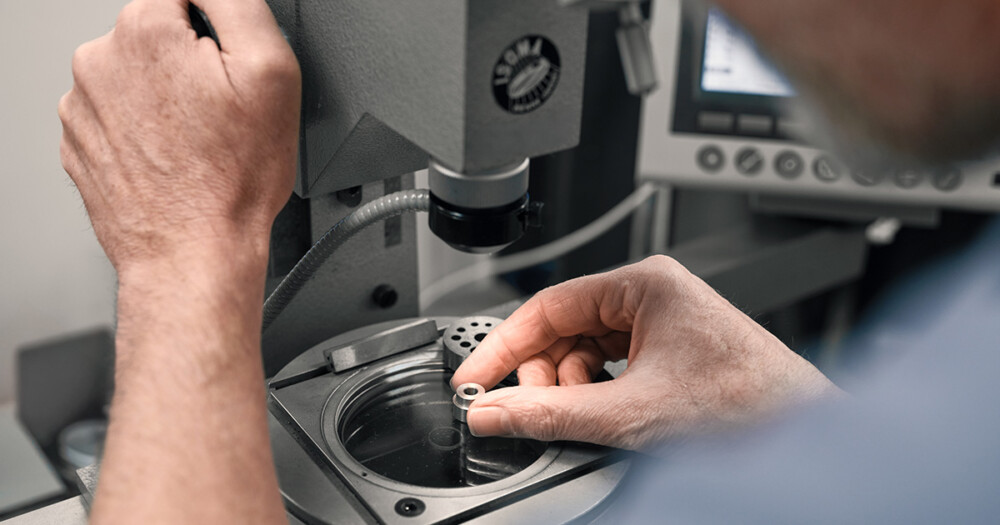
- Calibrated measuring equipment: Whether a calliper, a micrometer or a 3D coordinate measuring machine, all measuring equipment is subject to defined calibration intervals. Only calibrated equipment delivers comparable results over years.
Series stability is independent of the manufacturing process used. What matters is that processes are documented, validated and reproducible — whether production runs on conventional single-spindle automatics, CNC single-spindle turning centres, multi-spindle automatics or rotary transfer machines.
The costs that do not appear in the unit price
Procurement costs consist of considerably more than unit price. The largest costs frequently arise not at the point of purchase, but from the internal effort generated by quality and delivery problems.
- Additional inspection effort: When deliveries repeatedly show quality deviations, goods inward inspection is often intensified. That ties up personnel and extends internal lead times.
- Internal processing effort: Non-conformances generate work for quality management, purchasing and production — from root cause analysis through supplier communication to corrective action documentation.
- Production stoppages: When defective material cannot be replaced in time, assembly or downstream processing can be delayed. The costs this generates frequently exceed the value of the affected turned parts several times over.
- Field non-conformances: When quality problems only become apparent at the end customer, costs arise for analysis, coordination, replacement and service call-outs — a multiple of the original part price.
Summary: Series stability is not a quality characteristic — it is a procurement strategy.
The lowest unit price and the lowest total costs are rarely the same thing. Comparing unit prices alone means seeing only a fraction of the actual procurement costs. What is missing are the costs of incoming inspection, non-conformance handling, production stoppages and field failures — and those arise precisely where series stability is absent.
Series stability is the product of documented processes, validated parameters, complete traceability and a quality system that functions not only when an audit is imminent. It does not reveal itself in the first article sample. It reveals itself in the tenth repeat order, produced two years later, with fresh tooling and a different raw material batch.
Those who factor this into their supplier selection make the better decision — not only in the short term, but across the entire service life of the component.
If you have specific questions about series stability or our manufacturing processes, please do not hesitate to get in touch.
Frequently Asked Questions (FAQ)
-
What does series stability in precision turned parts actually mean?
Series stability means that a repeat order delivers the same results as the first — even when it is manufactured months later. Within a single order, all parts run with the same process parameters. The challenge lies in reproducibility across multiple orders over time.
-
How does batch traceability work in practice for precision turned parts?
Every batch receives a unique lot number, linked to the raw material certificate (heat number and material standard), the production order (machine, date, process parameters) and the inspection record (measured values, inspector). This information remains available on demand.
-
Why do some suppliers suddenly show a drop in quality after two years?
Because many of the underlying conditions change over time: new raw material batches, replaced tooling, machine changes or personnel turnover. What matters, therefore, is not that everything stays the same, but that the manufacturing process is so well documented and controlled that the same quality is achieved despite these changes. That is precisely where a manufacturing partner’s series stability reveals itself.
-
Why is tooling management important?
The quality of a precision turned part depends not only on the machine but on the condition of the tooling in use. As cutting tools accumulate running time, they wear — and that affects dimensions, surface quality and process reliability. A professional tooling management programme defines when tools are checked, re-ground or replaced. For the customer, this means reproducible components, fewer non-conformances and higher delivery reliability.
-
Is a successful first article sample sufficient to evaluate a supplier?
No. A first article sample demonstrates that a component could be produced successfully on one occasion. Whether a supplier delivers the same quality reproducibly on repeat orders, with new raw material batches and after tool changes, is only revealed by a controlled series process. That is why series stability is an essential criterion in supplier evaluation.
-
Who are Häni + Co. AG?
Häni + Co. AG is a Swiss family business based in Arch in the canton of Berne. Founded in 1939, the company has manufactured custom precision turned parts for demanding industrial applications for over 80 years. Its capabilities encompass conventional and CNC-controlled single-spindle automatics, multi-spindle machines and rotary transfer machines, together with in-house finishing operations including centreless grinding, honing, vibratory finishing and roller burnishing. Häni + Co. AG holds certifications to ISO 9001, ISO 14001, ISO 13485 and IATF 16949, and supplies customers in building services, medical technology, interconnect technology, sensor technology, robotics and automotive. Diameter range: Ø 1 to 65 mm.
-
Which sectors does Häni + Co. AG supply?
Building services, medical technology, interconnect technology, sensor technology, robotics, fluid technology and automotive. Typical components include shafts, axles, bushings, pinions, valve spindles, contact pins and connector elements. Swiss Precision since 1939.